Sunday, February 8, 2009

Fractal Food


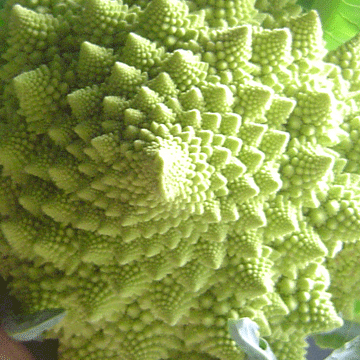
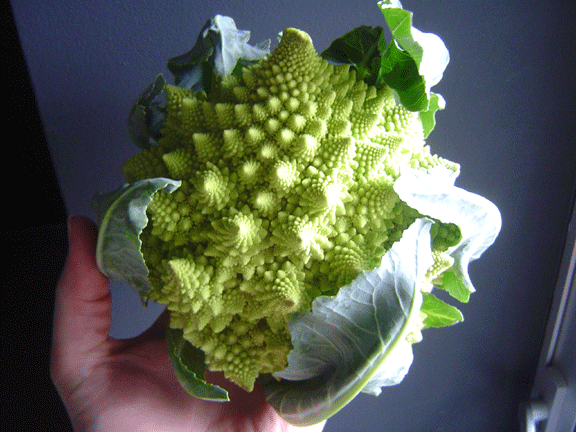
Yesterday morning at the Austin farmer's market, Sarah pointed out some Romanesco cauliflower to me.  This  fractal food is so pretty that we had to get one!  Sarah teased me on the way home for coddling it like a baby, and I must admit that except for the fact that it will go bad otherwise, I don't know that I could ingest something this beautiful.  I'd rather display it on our book shelf.

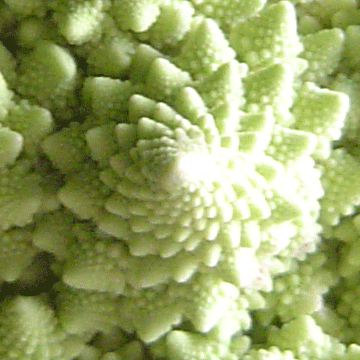
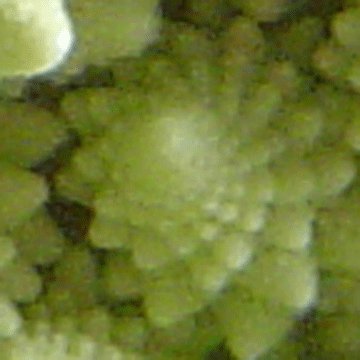
I took the following pictures of successive, self-similar levels of my little bundle.  Our aging camera wasn't quite up to the task, but I could get 3 levels pretty well.  In person, you can see an additional 4th level (bumps on the bumps in the final picture).


The Fibonacci sequence lives here.
In the botanical application of the Fibonacci numbers, plant outgrowths seek an optimum amount of living space and in so doing sprout in a pattern of intercrossing "whorls."  In a sunflower, where the buds become seeds, one family of 55 clockwise whorls intersects another family of 89 counterclockwise whorls - 55 and 89 being successive Fibonacci numbers.
Siobhan Roberts, King of Infinite Space, p259
Sure enough, I counted the number whorls to be 8 and 13 (the 6th and 7th Fibonacci numbers), regardless of the fractal level!  Sometimes the 8 whorls were clockwise, sometimes counterclockwise, and the direction changed even among outgrowths of the same level.  It'd be interesting to study the pattern of whorl directions to figure out what makes them flip.  I did notice outgrowths with similar whorl directions tend to clump together.

$4 was a steal for all this math magic!

Saturday, February 7, 2009

The Nature of Man

Does 00 = 1 or 0?  Does a human = good or evil?  It appears a bit confusing when you note the following:

x0 = 1 for any x not equal to 0.
0y = 0 for any y not equal to 0.

"Consensus has recently been built around setting the value of 0^0 = 1."

For these questions, I think I might like the answer "yes" better :) It depends on the context.

Tuesday, January 20, 2009

Reno and Mathematical Earrings for the Holidays

Sarah and I went to Reno over the holidays with her brother Jon and her parents Larry and Paulette. We were visiting her grandparents Fred and Bev, who live about 40 minutes outside Reno in a beautiful, isolated area. Cell phone reception was a fraction of a bar, and this was a plus for getting away. The "kids" (I'll never grow up) got to camp out in their trailer, which turned into a big adventure on Christmas night with the heater broken and freezing temperatures. Jon, Sarah, and I sequestered ourselves into the small bedroom with a surface heater, and it was fun - probably much easier for Sarah and me since we could cuddle up. There was no snow when arriving or leaving, but we had a lucky white Christmas! We also snuck in two half-days of snowboarding, the first time ever for Jon, Sarah's second outing, and my first in about two years. That was more great fun, and here are some pics and video from the week. Sadly, when taking pictures in the snow, I'm like Chandler in that one Friends episode.


On the return home, Sarah saw a pair of earrings in the airport that she thought I would like for mathematical reasons. She was right on! Any time circles get involved, you can pretty much bet things have an interesting mathematical interpretation, but these earrings are considerably rich for generating discussion.  And lucky for Sarah, her mom bought them for her.


If we consider the outer circle as the boundary of the Poincare disk model of the hyperbolic plane, there are three horocycles and one h-circle in this earring. The horocycles are tangent to the boundary, or "circle at infinity", and the h-circle is floating in the interior. By h-circle, I mean residents of the hyperbolic plane would see it as a circle, that is a set of points a fixed distance from a center. The Euclidean center of the h-circle in the model (what you see as the circle center) doesn't coincide with the center of the circle the residents would perceive however - that only happens for h-circles having centers at the Euclidean center of the disk.

No geodesics (straight h-lines) are in these earrings, as those would be segments of circles orthogonal to the boundary of the disk. Two of the horocycles (one is the tiny circle with the stone in it) are tangent to each other, meeting at a single point. Noticing this reinforced their non-geodesic character to me, for if they were straight lines and met at some interior point, they'd necessarily intersect.

Moving away from hyperbolic geometry, it is also neat to note the three intersecting circles in the middle are mutually orthogonal to each other! (or quite close to it anyway given the imperfections of this physical model). What's cool about that is inverting any of those three circles in the others will leave the shape invariant. Furthermore, if we invert any two of the circles in the third, the two intersection points of the first two circles are swapped.

While not as directly related, the earrings are reminiscent of a Wolfram Demonstration recently posted by Ed Pegg, Jr. about The Circles of Descartes. On that page, he shares a portion of a poem by Frederick Soddy called The Kiss Precise. I've also seen this poem in an engaging biography of the geometer Donald Coxeter called King of Infinite Space. The theorem described by the poem isn't exhibited in the earrings (close, but there are only three mutually tangent circles, not four), but as I still feel it is befitting, here is the full version (I like the generalization to spheres in the third verse).

The Kiss Precise by Frederick Soddy

For pairs of lips to kiss maybe
Involves no trigonometry.
This not so when four circles kiss
Each one the other three.
To bring this off the four must be
As three in one or one in three.
If one in three, beyond a doubt
Each gets three kisses from without.
If three in one, then is that one
Thrice kissed internally.

Four circles to the kissing come.
The smaller are the benter.
The bend is just the inverse of
The distance form the center.
Though their intrigue left Euclid dumb
There's now no need for rule of thumb.
Since zero bend's a dead straight line
And concave bends have minus sign,
The sum of the squares of all four bends
Is half the square of their sum.

To spy out spherical affairs
An oscular surveyor
Might find the task laborious,
The sphere is much the gayer,
And now besides the pair of pairs
A fifth sphere in the kissing shares.
Yet, signs and zero as before,
For each to kiss the other four
The square of the sum of all five bends
Is thrice the sum of their squares.
        - Nature 137, 1021 - 1021 (20 Jun 1936)
Saturday, December 20, 2008

Time Lapse

A 10-to-1 compressed video of Noel's Magic120Cell solution. Happy Holidays!

Sunday, December 14, 2008

Magic120Cell Solved!


In a bit of a coincidence to the last post, the formidable permutation puzzle version of the 120 cell I published this year has been solved for the first time. Noel Chalmers posted this announcement to the 4D cubing group last night.  I have genuinely wondered if this might never happen, and as a result feel a strange urge to alert the press!

I am relieved the software held up to the task. His solution had over 33 thousand moves, which took about 40 minutes just to play back on my computer using the fastest move speed. It feels really good to have had a hypercubing enthusiast put that much effort into something I helped create.  A lot of love went into it earlier this year, and even as far back as 2006 when the hope of it was initially started, so it really is neat that an actual solution is now realized.

Sunday, December 7, 2008

120 Cell Animations

Here are a couple quick videos of the 120 cell made for your enjoyment using 120 Cell Explorer. The animations show how the appearance of this object would change as we rotate our viewpoint around it in 4D.

Both show half of the 120 cells and color the cells based on which "ring" they are on. The highly symmetric 120 cell can be thought of as composed of 12 rings of 10 cells each, hence these animations are showing 6 of the 12 rings. One ring (the purple one) is more difficult to see because it is surrounded by the 5 others. All of the rings are linked to every other ring exactly once, so unless you were a magician, you couldn't pull any 2 of the rings apart without breaking one of them. Can you see the linking?


The next video is slightly more interesting to me. It is essentially identical to the first one except that we are starting from a different vantage point in 4D.

Wednesday, December 3, 2008

G3D Blog

I started a Gravitation3D blog this week.  Nope, I'm not masochistic and trying to burden myself with another project.  On the contrary, I did it after getting a flux of questions about the same time I read this article from a coding blog I like.  It took an hour or two to setup the new blog to a reasonable liking, but now every time I get a G3D question, I can answer it there instead of with an email (which would only shortly after be sentenced to a life term of solitude in my gmail).  I don't get a lot of emails about G3D, but over time this will probably make it even less so.  I figure this will bring me much closer to my lifelong goal of having no external sensory inputs impinge on my overly introverted self.

Why a wordpress blog this time instead of blogger?  I've discovered wordpress has support for LaTex, which allows nice display of mathematical formulas, and I think this will be important for some G3D posts.  There are roundabout ways to do this in blogger too (see here, here, or here), but I found this too troublesome - it didn't seem to work as well or look as nice as the native wordpress support.  

It's funny, since google gives you so much for free and at such high quality, I have found myself frustrated on more than one occasion when they haven't solved a problem for me that feels like it should be solved (like LaTex support for any html I publish).  Once I'm aware of this reaction, I realize it's a ridiculous sentiment, but I'd be lying if I said it doesn't crop up now and then (No good deeds go unpunished).