
Saturday, June 3, 2017
Where am I?
I have not posted here in a long time, but continue to be active with mathematics. If you'd like to see more mathematical imagery and read about it, please visit my G+ feed or check my website. Maybe I'll be back here some day, maybe not.


Friday, September 6, 2013
The dual {5,3,4} and {4,3,5}
I've been collaborating with +Henry Segerman to create some physical models of hyperbolic honeycombs, and here is one of the first we made, the {5,3,4}. If you would like to order one of these for yourself, information is at the bottom of this post.


What is a honeycomb?
It is when you take a bunch of polyhedra and pack them together with no gaps. The polyhedra in a honeycomb are called "cells". This particular honeycomb is a perfectly regular repeating pattern of dodecahedra, four surrounding each edge. For this reason, it is also called the Order-4 Dodecahedral Honeycomb.
Why is it hyperbolic?
Hyperbolic geometry is a space where the angles of a triangle add up to less than 180 degrees. The other kinds of geometries are Euclidean (angles add to 180 degrees) and spherical (angles add to more than 180 degrees). If you try to pack four dodecahedra around an edge in Euclidean or spherical space, they don't fit because angles are too big. But in hyperbolic geometry, you can make them fit.
Hyperbolic space can't fit into our normal Euclidean space, so this is a model of hyperbolic space called the Poincaré Ball model. The infinity of hyperbolic space is compressed to the size of a ball, and as you might imagine, that results in some distortion. Dodecahedra appear smaller and smaller as they approach the spherical surface of the ball, but the dodecahedra are all identical in hyperbolic space. Although visually warped, the ball model preserves all angles: it is "conformal".
Our prints render edges of the honeycomb, and we've scaled them accurately (verses making them constant width). For this reason, the edges appear thinner towards the ball surface. The edge shrinking dictates how much of the honeycomb we can include, because as you add more layers of cells, edges eventually become so thin that a printed model would be too fragile.
Our prints render edges of the honeycomb, and we've scaled them accurately (verses making them constant width). For this reason, the edges appear thinner towards the ball surface. The edge shrinking dictates how much of the honeycomb we can include, because as you add more layers of cells, edges eventually become so thin that a printed model would be too fragile.
What does the cryptic "{5,3,4}" mean?
That is something called the Schläfli symbol, and it is wonderfully descriptive (and recursive!). We can start at the left and work our way to the right to understand the meaning and build up a honeycomb. The Schläfli symbol for a pentagon is {5} because it has 5 sides. The symbol for a dodecahedron is {5,3}, which means that 3 pentagons meet at every vertex. So the first number specifies a particular polygon and the second number describes how to connect up those polygons around a vertex.

The third number continues the trend. It describes how to connect up cells specified by the first two numbers. So the 4 at the end of {5,3,4} means that four dodecahedra surround each edge. Each time we add a number to a Schläfli symbol, we end up describing an object of one higher dimension: first polygons, then polyehedra, then polytopes...
Something else is hidden in the Schläfli symbol of our honeycomb: the last two numbers taken together have meaning. For the {5,3,4}, we're talking about {3,4}. Remember {3} represents a triangle, and {3,4} means that four triangles meet at every vertex. This is the octahedron.

How is the octahedron is meaningful for this honeycomb? It is the the vertex figure, which describes the geometry of how dodecahedra meet at each vertex in the honeycomb. Eight dodecahedra meet at every vertex, one for each face of the octahedron.
What a crazy amount of information compressed into three numbers!
There are four regular honeycombs in hyperbolic space (and eleven more if you loosen the definition a little). Each of these has a unique Schläfli symbol, and so the symbol is a great way to quickly understand how a particular honeycomb is built up. The symbols also work for honeycombs in Euclidean and spherical space.
Now let's check out the {4,3,5}


Can you break down the symbol to understand how this one is built up? What polygon lives throughout? What are the polyhedral cells? How many cells fit around an edge? What is the vertex figure?
The {4,3,5} is the "dual" of the {5,3,4}, so locations of all the element types are exchanged. Where there are cells, polygons, edges, and vertices in one, you respectively have vertices, edges, polygons, and cells in the other. And maybe you just noticed something else about the Schläfli symbol... dual objects have reversed symbols. Self-dual objects have palindromic Schläfli symbols!
You can order your own prints of both these models (and more exotic honeycombs) at my shapeways shop.
If you'd like to dig more, see Coxeter's paper, "Regular Honeycombs in Hyperbolic Space", available in Chapter 10 of the book "The Beauty of Geometry" or online here.
Sunday, July 1, 2012
Recursive Circle Inversions
I played around with recursive circle inversions this weekend. A circle inversion is like a reflection in a mirror, except the mirror is curved. I start out with a small set of tangent circles, then repeatedly reflect all the circles in each other. The fractal results can be pretty dramatic...


Lots of {3,infinity} hyperbolic tessellations floating around!
If you like these images, I highly recommend the book Indra's Pearls.
Tuesday, December 13, 2011
Dodecahedron in Disguise
I like this image, created while experimenting with MagicTile last night.


It is a spherical dodecahedron with a set of five concentric circles surrounding each vertex, and stereographically projected to the plane.
Sunday, December 11, 2011
Interference Patterns
Edmund Harris recently posted some beautiful pictures created with modular arithmetic. I was surprised and intrigued to see this one, because it so closely resembled an image I made some years ago without thinking about modular arithmetic at all. I dug through my disorganized backups, and finally found it from circa 2004.

These images don't resize well. The scaling can both remove structure and produce artifacts that are not in the original, so here is an example detail portion of the full image.

You can click here for the full version (4.5 MB).
These images are fractal looking, with repeating patterns at smaller scales. You can see the integers and fractions living in there. Perhaps cooler, the smaller repetitions seem to exist on a "higher level" than the basic repeating unit. They float along the patterns below, having a sort of ethereal existence.
If Edmund used modular arithmetic, how was my image made? Consider the function sin(x2). Here is a plot of it in the range of 0 to 15. You can see the frequency of the oscillations is increasing quickly with larger x.

Now consider sampling this function at discrete values of x in the larger range of 0 to 1000. When you get to higher values of x, this continuous function is oscillating back and forth a huge number of times between each successive value of x. Is there a pattern to be seen in the discretely sampled output values?
Finding a pattern on a 1D line is not so easy, but you can plot discrete values of sin(d2) on a 2D grid, where d is the distance of an image pixel to the origin. When the function value for each discrete pixel is calculated and plotted as a color, voila! The image appears, and the patterns undeniably jump out.
At the time, I attributed the effect to a Moire-like phenomenon, with an interference between the discrete grid of pixels and the continuous function. It was neat to read Edmund's explanation that modular arithmetic is behind the scenes. Maybe modular arithmetic is part of the magic behind Moire patterns?
I experimented with other functions as well, and here is a favorite. I love that it has both elliptical and hyperbolic patterns in it, and the transitioning between the two.


You can click here for the full version (2 MB).
Tuesday, May 17, 2011
Three Different Views of the Same Tiling
Here are three images of the same {4,6} tiling. The "{4,6}" notation is called the Schläfli symbol. The 4 means it is a tiling of squares. The 6 means that 6 squares meet at every vertex. Check it in the pictures!


A view centered on a square:

A view centered on an edge:

A view centered on a vertex:

I bet you noticed that the tiling is checkerboarded (hyperbolic chess anyone?). Can you figure out what property is required to allow a tiling to be checkerboarded? If so, let me know in the comments!
Q: What made these pictures?
A: The MagicTile v2 Preview (requires .NET 4 Framework).
Sunday, April 17, 2011
Geodesic Saddles
It's highly likely you've seen a geodesic dome before.

After briefly starting to optimize triangle counts for textures in MagicTile, I had a fun realization. The triangle patterns sparked the idea that there could be a precise hyperbolic analogue to a geodesic dome. I was compelled into the diversion, and with minor code changes made some pretty pictures of "geodesic saddles". (That seems like a nice name for these objects anyway.) Alas, my intended optimizations are yet to be done, but at least I can present this geodesic saddle based on the {3,7} tiling :)

Can you find some of the "knots"? That may not be the proper term, but I mean those rare points in the saddle where seven triangles meet at a vertex instead of six. On a geodesic dome, which is usually based on the spherical {3,5} tiling (aka icosahedron), the analogous points are the rare vertices where five triangles meet instead of six. I find knots easier to spot on a geodesic saddle derived from a {3,9} tiling.

Geodesic domes and saddles are generated by taking the tiles in a triangular tiling and subdividing each of them into smaller triangles. Hence, triangular numbers make a cameo in the calculations. For these pictures, I chose to subdivide the original triangles with eight new triangles per side.
But there was one thing that tripped me up quite a bit. I began by mistakenly thinking I could subdivide the triangle edges of the original tiling equally, and then interpolate interior points thereafter. As much as I tried, things just wouldn't line up quite right, and I wasn't seeing the geodesics that I expected. It turns out that all the small triangle edges have varying lengths, something that is also true for a geodesic dome. Compare the proper {3,9} geodesic saddle above with the waviness of an incorrect effort.

I've been showing these pictures in the Poincare Disk, and I don't have unprojected renderings at the moment. But despite this, one thing is certain - a portion of geodesic saddle would make for a unique and fantastic jungle gym!

Related links:
Friday, April 1, 2011
Tragedy of the Commons (and more)
The whole world is a comedy to those that think, a tragedy to those that feel.-Horace Walpole
Can you guess which camp I'm in? My answer told me a little something about me.
I tip my hat to AbstruseGoose for the quote (my favorite online comic by orders of magnitude)...
Monday, March 28, 2011
Happy Bugs
Programming mistakes might usually lead to a crash, lost work, tears, etc., but here are a couple pleasant surprises courtesy of MagicTile coding goofs.
The following was caused by a coloring bug. I accidentally left out a line of code, which caused the yellow and black outline colors to take over in a completely unexpected way.

This past weekend, I was testing slicing off the tips of polygons in a hyperbolic tiling, and saw this beautiful, fortuitous image appear on my screen.

The cause... I had failed to tell the slicing code to recalculate the centers of the sliced up pieces, so they were way off from where they should have been. The intended (much less satisfying) outcome was this.

I liked the unanticipated effect, so captured a couple more pictures before fixing the bug :)


Monday, July 26, 2010
Appreciating Creativity
I've always liked reading the dedication in books before I start them. Here are a couple I ran into this past year whose creativity made me smile.
from On Quaternions and Octonions by John Conway and Derek Smith:
This book is dedicated to Lilian Smith and Gareth Conway, without whom we would have finished this book much sooner.
from Nonplussed!: Mathematical Proof of Implausible Ideas by Julian Havil:
To Anne
for whom my love is monotone increasing
and unbounded above
I can relate to both sentiments :)
Thursday, December 24, 2009
Happy Holidays
 What is this?
Besides possibly a festive tree ornament, it is a sneak preview of a new Rubik analogue program I've been playing with this past year
We live on an island surrounded by a sea of ignorance. As our island of knowledge grows, so does the shore of our ignorance.- John Wheeler
I saw that quote this week on John Baez's site, and ground zero on my personal island appears to be the Rubik's Cube.
Anyway, the picture above is a checkerboard pattern made by twisting up a puzzle based on a regular tiling of octagons, which requires hyperbolic geometry to fit together, naturally! The octagonal faces are delineated by yellow edges, and the black circles slice them up into stickers. This particular puzzle has 6 unique face colors which repeat in a certain pattern, and that pattern is interesting to study in itself. All the faces having the same center colors are actually identical and twist together. Kaleidoscopical to watch :D
Best wishes to all my readers in 2010. I love all three-or-so of you!
Saturday, August 29, 2009
In Praise of (Blogging) Idleness
This entertaining essay by Bertrand Russell begins:
Like most of my generation, I was brought up on the saying: 'Satan finds some mischief for idle hands to do.' Being a highly virtuous child, I believed all that I was told, and acquired a conscience which has kept me working hard down to the present moment. But although my conscience has controlled my actions, my opinions have undergone a revolution. I think that there is far too much work done in the world, that immense harm is caused by the belief that work is virtuous, and that what needs to be preached in modern industrial countries is quite different from what always has been preached.So why the dystopia of the world instead of Russell's four hour work days? Scott Aaronson provided a good explanation of why it has to be this way:
Why can’t everyone just agree to a family-friendly, 40-hour workweek? Because then anyone who chose to work a 90-hour week would clean our clocks.And Parkinson's Law surely plays a role in the dynamics of it all:
...
Again and again, I’ve undergone the humbling experience of first lamenting how badly something sucks, then only much later having the crucial insight that its not sucking wouldn’t have been a Nash equilibrium.
Work expands so as to fill the time available for its completion.Whew, well that's enough posting for me - back to another 6 months of leisurable, blog-free bliss...
Monday, March 2, 2009
Knitting Math

In the January issue of the Notices of the American Mathematical Society, I fortuitously saw an A K Peters publishing ad for a new book by Daina Taimina titled Crocheting Adventures with Hyperbolic Planes. A whole book by an author of the paper I had previously found! It wasn't then available, but I preordered a copy immediately, and today I excitedly received it. This is a beautiful book, and I'm going to love it. After flipping through and enjoying the multitude of pictures, the forward by William Thurston started off the reading experience perfectly.
Many people have an impression, based on years of schooling, that mathematics is an austere and formal subject concerned with complicated and ultimately confusing rules for the manipulation of numbers, symbols, and equations, rather like the preparation of a complicated income tax return, where there are myriad unexplained steps, rules, exceptions, and gotchas.
Good mathematics is quite opposite to this. Mathematics is an art of human understanding.
My first impression is that this is a gentle, real-world-examples and hands on introduction to hyperbolic geometry. My sneak peek also showed there's more crocheting projects for me to learn in Taimina's work, and I'll surely be breaking out my hook again. I have to say I'm liking having this bridge between Sarah's and my interests.
By the way, "Knitting Math" was how a friend of ours described my crocheting adventures to some others when the term hyperbolic plane slipped her mind. I thought it was great :)
By the way, "Knitting Math" was how a friend of ours described my crocheting adventures to some others when the term hyperbolic plane slipped her mind. I thought it was great :)
Sunday, February 22, 2009
Searching for a little more hidden symmetry
A recent Geometry Junkyard post alerted me to a mathematical paper titled Fermat's Spiral and the Line Between Yin and Yang. The authors present an interesting argument for preferring a less typical yin-yang symbol (though not a symbol completely unseen before, as they point to a similar pattern on the Korean flag from the 19th century).
Hopefully this post will make the paper a little more accessible. I'm writing it for anyone who might ever ponder getting a tattoo of a yin-yang symbol, but who may also want to take the expression of balance a little deeper. For those who've already inked themselves, fret not because I'll present some rationale at the end suggesting the more familiar symbol is just as deeply balanced (in a meta sense at least).
Here are two candidate representations for an ideal yin-yang symbol...
 The light/dark boundary line of the first is made from two semi-circles. The latter is the alternative suggested in the paper, having a boundary based on Fermat's spiral. Both symbols have the symmetry that half of the area of the disk is light and half is dark. And both boundaries have a rotational symmetry - you can rotate the curve 180 degrees and it remains unchanged (though such a rotation of the disk does swap the light/dark areas).
I'd like to share a quote from the paper that goes to the heart of the argument, but will need to clarify a few terms they use first.
I wanted to see what the symmetric and asymmetric subsets of A looked like, so I wrote a short POV-Ray script to make an animation which runs through all the axial symmetries. For each symmetry, it reflects the darker half of the symbol as a lighter area, and the interaction of these two areas end up demarking the "maximum symmetric subsets" of A. For A taken to be the dark half, these are the darkest areas of intersection in the video.
If you pause the video, you'll be able to study the maximum symmetric subset with respect to a particular disk symmetry s. It's neat to note this subset is actually the union of two smaller disjoint sets, that is it is made up of two disconnected parts. This is also true for the corresponding asymmetric subset (a welcome "symmetry" of a different kind).
One property I find more "symmetric" about the prevalent semicircle yin-yang boundary is that it is tangent to the the outer disk. This is not true for Fermat's spiral (close but no cigar). I think it is often inevitable that to gain symmetry in one sense, you have to give it up in another seemingly disparate sense.
So having noted that, I'll close with the thought that maybe these two symbols are themselves foils for each other, faintly analogous to the dark/light areas of a single yin-yang. Perhaps they should not or could not exist in isolation to each other. In other words, you don't need to regret that tattoo in the small of your back :)
1 The imperfections of wikipedia led me astray in this. Their axial symmetry page didn't apply in this context and had me believing the paper was talking about rotations rather than reflections. I puzzled and puzzled over it (to the point of questioning my intelligence, though that is not uncommon). I couldn't make sense of the excerpt until the reflection symmetry page came to the rescue.
2 There are other perfect sets A of a disk, but the candidate yin-yang curves considered also arguably must manifest some other qualities of yin-yangness, so glossed over was that only Fermat's spiral has all those qualities in addition to cutting the disk into perfect sets.
Hopefully this post will make the paper a little more accessible. I'm writing it for anyone who might ever ponder getting a tattoo of a yin-yang symbol, but who may also want to take the expression of balance a little deeper. For those who've already inked themselves, fret not because I'll present some rationale at the end suggesting the more familiar symbol is just as deeply balanced (in a meta sense at least).
Here are two candidate representations for an ideal yin-yang symbol...
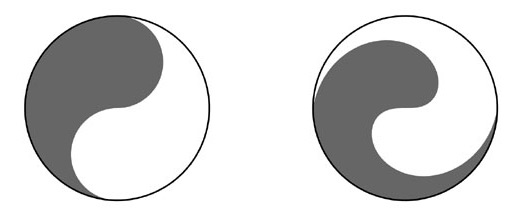 The light/dark boundary line of the first is made from two semi-circles. The latter is the alternative suggested in the paper, having a boundary based on Fermat's spiral. Both symbols have the symmetry that half of the area of the disk is light and half is dark. And both boundaries have a rotational symmetry - you can rotate the curve 180 degrees and it remains unchanged (though such a rotation of the disk does swap the light/dark areas).
I'd like to share a quote from the paper that goes to the heart of the argument, but will need to clarify a few terms they use first.
- They label the disk D and specify it has an area equal to 1.
- The area they call A can be taken to be either half of the yin-yang symbol based on Fermat's spiral, and has area 1/2.
- 'axial symmetry' means a reflection about an axis in the plane of the disk and going through the disk center1.
- By 'measure', they mean area. (The fancy term is Lebesgue measure.)
- By 'symmetric subset', they mean any subset of A that is fully the same color before and after a given reflection of the disk.
... we discovered a magic difference of the plane disk ... it contains a set AThe paper actually proves that a yin-yang symbol based on Fermat's spiral is the only one with this more subtle symmetry2. In this sense then, the symbol on the right has deeper symmetries than the one on the left.D of measure 1/2 all whose symmetric subsets have measure at most 1/4. Let us call such an A perfect. Any perfect set A has a remarkable property: For every axial symmetry s of D, the maximum subset of A symmetric with respect to s has measure 1/4. In words admitting far-going esoteric interpretations, perfect sets demonstrate a sharp equilibrium between their "symmetric" and "asymmetric" parts, whatever particular symmetry s is considered.
I wanted to see what the symmetric and asymmetric subsets of A looked like, so I wrote a short POV-Ray script to make an animation which runs through all the axial symmetries. For each symmetry, it reflects the darker half of the symbol as a lighter area, and the interaction of these two areas end up demarking the "maximum symmetric subsets" of A. For A taken to be the dark half, these are the darkest areas of intersection in the video.
If you pause the video, you'll be able to study the maximum symmetric subset with respect to a particular disk symmetry s. It's neat to note this subset is actually the union of two smaller disjoint sets, that is it is made up of two disconnected parts. This is also true for the corresponding asymmetric subset (a welcome "symmetry" of a different kind).
One property I find more "symmetric" about the prevalent semicircle yin-yang boundary is that it is tangent to the the outer disk. This is not true for Fermat's spiral (close but no cigar). I think it is often inevitable that to gain symmetry in one sense, you have to give it up in another seemingly disparate sense.
So having noted that, I'll close with the thought that maybe these two symbols are themselves foils for each other, faintly analogous to the dark/light areas of a single yin-yang. Perhaps they should not or could not exist in isolation to each other. In other words, you don't need to regret that tattoo in the small of your back :)
1 The imperfections of wikipedia led me astray in this. Their axial symmetry page
2 There are other perfect sets A of a disk, but the candidate yin-yang curves considered also arguably must manifest some other qualities of yin-yangness, so glossed over was that only Fermat's spiral has all those qualities in addition to cutting the disk into perfect sets.
Sunday, February 8, 2009
Fractal Food
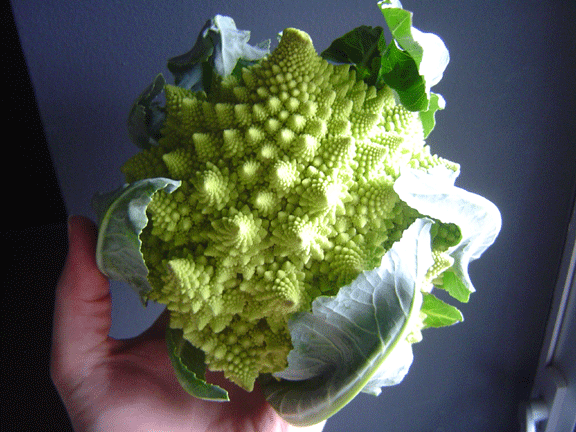
Yesterday morning at the Austin farmer's market, Sarah pointed out some Romanesco cauliflower to me. This fractal food is so pretty that we had to get one! Sarah teased me on the way home for coddling it like a baby, and I must admit that except for the fact that it will go bad otherwise, I don't know that I could ingest something this beautiful. I'd rather display it on our book shelf.
I took the following pictures of successive, self-similar levels of my little bundle. Our aging camera wasn't quite up to the task, but I could get 3 levels pretty well. In person, you can see an additional 4th level (bumps on the bumps in the final picture).
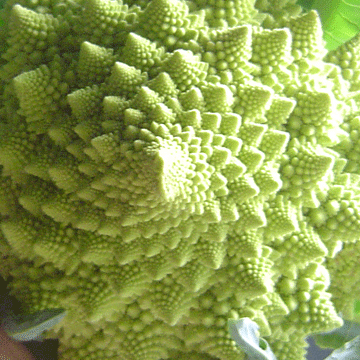
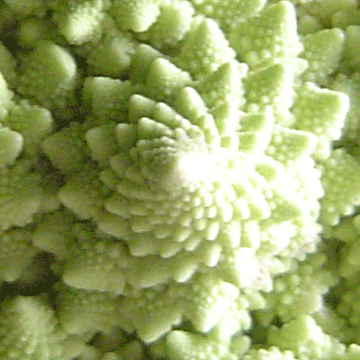
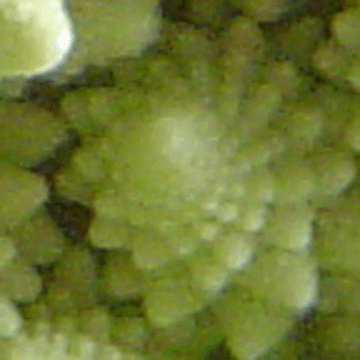
The Fibonacci sequence lives here.
In the botanical application of the Fibonacci numbers, plant outgrowths seek an optimum amount of living space and in so doing sprout in a pattern of intercrossing "whorls." In a sunflower, where the buds become seeds, one family of 55 clockwise whorls intersects another family of 89 counterclockwise whorls - 55 and 89 being successive Fibonacci numbers.
Siobhan Roberts, King of Infinite Space, p259Sure enough, I counted the number whorls to be 8 and 13 (the 6th and 7th Fibonacci numbers), regardless of the fractal level! Sometimes the 8 whorls were clockwise, sometimes counterclockwise, and the direction changed even among outgrowths of the same level. It'd be interesting to study the pattern of whorl directions to figure out what makes them flip. I did notice outgrowths with similar whorl directions tend to clump together.
$4 was a steal for all this math magic!
Saturday, February 7, 2009
The Nature of Man
Does 00 = 1 or 0? Does a human = good or evil? It appears a bit confusing when you note the following:
x0 = 1 for any x not equal to 0.
0y = 0 for any y not equal to 0.
"Consensus has recently been built around setting the value of 0^0 = 1."
For these questions, I think I might like the answer "yes" better :) It depends on the context.
x0 = 1 for any x not equal to 0.
0y = 0 for any y not equal to 0.
"Consensus has recently been built around setting the value of 0^0 = 1."
For these questions, I think I might like the answer "yes" better :) It depends on the context.
Tuesday, January 20, 2009
Reno and Mathematical Earrings for the Holidays
Sarah and I went to Reno over the holidays with her brother Jon and her parents Larry and Paulette. We were visiting her grandparents Fred and Bev, who live about 40 minutes outside Reno in a beautiful, isolated area. Cell phone reception was a fraction of a bar, and this was a plus for getting away. The "kids" (I'll never grow up) got to camp out in their trailer, which turned into a big adventure on Christmas night with the heater broken and freezing temperatures. Jon, Sarah, and I sequestered ourselves into the small bedroom with a surface heater, and it was fun - probably much easier for Sarah and me since we could cuddle up. There was no snow when arriving or leaving, but we had a lucky white Christmas! We also snuck in two half-days of snowboarding, the first time ever for Jon, Sarah's second outing, and my first in about two years. That was more great fun, and here are some pics and video from the week. Sadly, when taking pictures in the snow, I'm like Chandler in that one Friends episode.
On the return home, Sarah saw a pair of earrings in the airport that she thought I would like for mathematical reasons. She was right on! Any time circles get involved, you can pretty much bet things have an interesting mathematical interpretation, but these earrings are considerably rich for generating discussion. And lucky for Sarah, her mom bought them for her.

If we consider the outer circle as the boundary of the Poincare disk model of the hyperbolic plane, there are three horocycles and one h-circle in this earring. The horocycles are tangent to the boundary, or "circle at infinity", and the h-circle is floating in the interior. By h-circle, I mean residents of the hyperbolic plane would see it as a circle, that is a set of points a fixed distance from a center. The Euclidean center of the h-circle in the model (what you see as the circle center) doesn't coincide with the center of the circle the residents would perceive however - that only happens for h-circles having centers at the Euclidean center of the disk.
While not as directly related, the earrings are reminiscent of a Wolfram Demonstration recently posted by Ed Pegg, Jr. about The Circles of Descartes. On that page, he shares a portion of a poem by Frederick Soddy called The Kiss Precise. I've also seen this poem in an engaging biography of the geometer Donald Coxeter called King of Infinite Space. The theorem described by the poem isn't exhibited in the earrings (close, but there are only three mutually tangent circles, not four), but as I still feel it is befitting, here is the full version (I like the generalization to spheres in the third verse).
On the return home, Sarah saw a pair of earrings in the airport that she thought I would like for mathematical reasons. She was right on! Any time circles get involved, you can pretty much bet things have an interesting mathematical interpretation, but these earrings are considerably rich for generating discussion. And lucky for Sarah, her mom bought them for her.

If we consider the outer circle as the boundary of the Poincare disk model of the hyperbolic plane, there are three horocycles and one h-circle in this earring. The horocycles are tangent to the boundary, or "circle at infinity", and the h-circle is floating in the interior. By h-circle, I mean residents of the hyperbolic plane would see it as a circle, that is a set of points a fixed distance from a center. The Euclidean center of the h-circle in the model (what you see as the circle center) doesn't coincide with the center of the circle the residents would perceive however - that only happens for h-circles having centers at the Euclidean center of the disk.
No geodesics (straight h-lines) are in these earrings, as those would be segments of circles orthogonal to the boundary of the disk. Two of the horocycles (one is the tiny circle with the stone in it) are tangent to each other, meeting at a single point. Noticing this reinforced their non-geodesic character to me, for if they were straight lines and met at some interior point, they'd necessarily intersect.
Moving away from hyperbolic geometry, it is also neat to note the three intersecting circles in the middle are mutually orthogonal to each other! (or quite close to it anyway given the imperfections of this physical model). What's cool about that is inverting any of those three circles in the others will leave the shape invariant. Furthermore, if we invert any two of the circles in the third, the two intersection points of the first two circles are swapped.
While not as directly related, the earrings are reminiscent of a Wolfram Demonstration recently posted by Ed Pegg, Jr. about The Circles of Descartes. On that page, he shares a portion of a poem by Frederick Soddy called The Kiss Precise. I've also seen this poem in an engaging biography of the geometer Donald Coxeter called King of Infinite Space. The theorem described by the poem isn't exhibited in the earrings (close, but there are only three mutually tangent circles, not four), but as I still feel it is befitting, here is the full version (I like the generalization to spheres in the third verse).
The Kiss Precise by Frederick Soddy
For pairs of lips to kiss maybe
Involves no trigonometry.
This not so when four circles kiss
Each one the other three.
To bring this off the four must be
As three in one or one in three.
If one in three, beyond a doubt
Each gets three kisses from without.
If three in one, then is that one
Thrice kissed internally.
Four circles to the kissing come.
The smaller are the benter.
The bend is just the inverse of
The distance form the center.
Though their intrigue left Euclid dumb
There's now no need for rule of thumb.
Since zero bend's a dead straight line
And concave bends have minus sign,
The sum of the squares of all four bends
Is half the square of their sum.
To spy out spherical affairs
An oscular surveyor
Might find the task laborious,
The sphere is much the gayer,
And now besides the pair of pairs
A fifth sphere in the kissing shares.
Yet, signs and zero as before,
For each to kiss the other four
The square of the sum of all five bends
Is thrice the sum of their squares.
- Nature 137, 1021 - 1021 (20 Jun 1936)
Saturday, December 20, 2008
Sunday, December 14, 2008
Magic120Cell Solved!

In a bit of a coincidence to the last post, the formidable permutation puzzle version of the 120 cell I published this year has been solved for the first time. Noel Chalmers posted this announcement to the 4D cubing group last night. I have genuinely wondered if this might never happen, and as a result feel a strange urge to alert the press!
I am relieved the software held up to the task. His solution had over 33 thousand moves, which took about 40 minutes just to play back on my computer using the fastest move speed. It feels really good to have had a hypercubing enthusiast put that much effort into something I helped create. A lot of love went into it earlier this year, and even as far back as 2006 when the hope of it was initially started, so it really is neat that an actual solution is now realized.
Sunday, December 7, 2008
120 Cell Animations
Here are a couple quick videos of the 120 cell made for your enjoyment using 120 Cell Explorer. The animations show how the appearance of this object would change as we rotate our viewpoint around it in 4D.
Both show half of the 120 cells and color the cells based on which "ring" they are on. The highly symmetric 120 cell can be thought of as composed of 12 rings of 10 cells each, hence these animations are showing 6 of the 12 rings. One ring (the purple one) is more difficult to see because it is surrounded by the 5 others. All of the rings are linked to every other ring exactly once, so unless you were a magician, you couldn't pull any 2 of the rings apart without breaking one of them. Can you see the linking?
The next video is slightly more interesting to me. It is essentially identical to the first one except that we are starting from a different vantage point in 4D.
Subscribe to:
Posts (Atom)


 Posts


