Monday, July 26, 2010

Appreciating Creativity

I've always liked reading the dedication in books before I start them. Here are a couple I ran into this past year whose creativity made me smile.

from On Quaternions and Octonions by John Conway and Derek Smith:
This book is dedicated to Lilian Smith and Gareth Conway, without whom we would have finished this book much sooner.

from Nonplussed!: Mathematical Proof of Implausible Ideas by Julian Havil:
To Anne
for whom my love is monotone increasing
and unbounded above

I can relate to both sentiments :)

Thursday, December 24, 2009

Happy Holidays

What is this?

Besides possibly a festive tree ornament, it is a sneak preview of a new Rubik analogue program I've been playing with this past year but have yet to publish (update: I put a version of this online in late January). One can bring to light a huge set of puzzles by considering the original cube puzzle as a special case where the colored faces are a regular tiling of squares, and then abstracting by asking "What is the most precise analogue for other polygonal tilings?". For me, this simple question lead to all kinds of engrossing pathways, discoveries, and of course... many more questions.

We live on an island surrounded by a sea of ignorance. As our island of knowledge grows, so does the shore of our ignorance.
- John Wheeler

I saw that quote this week on John Baez's site, and ground zero on my personal island appears to be the Rubik's Cube.

Anyway, the picture above is a checkerboard pattern made by twisting up a puzzle based on a regular tiling of octagons, which requires hyperbolic geometry to fit together, naturally! The octagonal faces are delineated by yellow edges, and the black circles slice them up into stickers. This particular puzzle has 6 unique face colors which repeat in a certain pattern, and that pattern is interesting to study in itself. All the faces having the same center colors are actually identical and twist together. Kaleidoscopical to watch :D

Best wishes to all my readers in 2010. I love all three-or-so of you!

Saturday, August 29, 2009

In Praise of (Blogging) Idleness

This entertaining essay by Bertrand Russell begins:
Like most of my generation, I was brought up on the saying: 'Satan finds some mischief for idle hands to do.' Being a highly virtuous child, I believed all that I was told, and acquired a conscience which has kept me working hard down to the present moment. But although my conscience has controlled my actions, my opinions have undergone a revolution. I think that there is far too much work done in the world, that immense harm is caused by the belief that work is virtuous, and that what needs to be preached in modern industrial countries is quite different from what always has been preached.
So why the dystopia of the world instead of Russell's four hour work days? Scott Aaronson provided a good explanation of why it has to be this way:
Why can’t everyone just agree to a family-friendly, 40-hour workweek? Because then anyone who chose to work a 90-hour week would clean our clocks.

...

Again and again, I’ve undergone the humbling experience of first lamenting how badly something sucks, then only much later having the crucial insight that its not sucking wouldn’t have been a Nash equilibrium.
And Parkinson's Law surely plays a role in the dynamics of it all:
Work expands so as to fill the time available for its completion.
Whew, well that's enough posting for me - back to another 6 months of leisurable, blog-free bliss...

Monday, March 2, 2009

Knitting Math


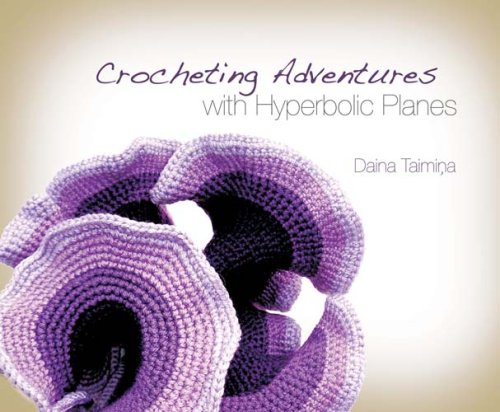
In the January issue of the Notices of the American Mathematical Society, I fortuitously saw an A K Peters publishing ad for a new book by Daina Taimina titled Crocheting Adventures with Hyperbolic Planes. A whole book by an author of the paper I had previously found!  It wasn't then available, but I preordered a copy immediately, and today I excitedly received it.  This is a beautiful book, and I'm going to love it.  After flipping through and enjoying the multitude of pictures, the forward by William Thurston started off the reading experience perfectly.
Many people have an impression, based on years of schooling, that mathematics is an austere and formal subject concerned with complicated and ultimately confusing rules for the manipulation of numbers, symbols, and equations, rather like the preparation of a complicated income tax return, where there are myriad unexplained steps, rules, exceptions, and gotchas.
        Good mathematics is quite opposite to this. Mathematics is an art of human understanding.
My first impression is that this is a gentle, real-world-examples and hands on introduction to hyperbolic geometry.  My sneak peek also showed there's more crocheting projects for me to learn in Taimina's work, and I'll surely be breaking out my hook again.  I have to say I'm liking having this bridge between Sarah's and my interests.  

By the way, "Knitting Math" was how a friend of ours described my crocheting adventures to some others when the term hyperbolic plane slipped her mind. I thought it was great :)

Sunday, February 22, 2009

Searching for a little more hidden symmetry

A recent Geometry Junkyard post alerted me to a mathematical paper titled Fermat's Spiral and the Line Between Yin and Yang. The authors present an interesting argument for preferring a less typical yin-yang symbol (though not a symbol completely unseen before, as they point to a similar pattern on the Korean flag from the 19th century).

Hopefully this post will make the paper a little more accessible. I'm writing it for anyone who might ever ponder getting a tattoo of a yin-yang symbol, but who may also want to take the expression of balance a little deeper. For those who've already inked themselves, fret not because I'll present some rationale at the end suggesting the more familiar symbol is just as deeply balanced (in a meta sense at least).

Here are two candidate representations for an ideal yin-yang symbol...
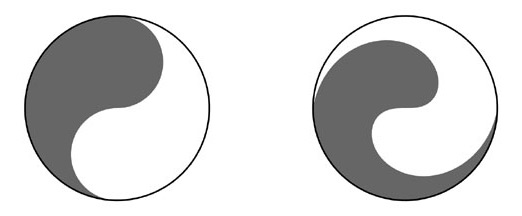
The light/dark boundary line of the first is made from two semi-circles. The latter is the alternative suggested in the paper, having a boundary based on Fermat's spiral. Both symbols have the symmetry that half of the area of the disk is light and half is dark. And both boundaries have a rotational symmetry - you can rotate the curve 180 degrees and it remains unchanged (though such a rotation of the disk does swap the light/dark areas).

I'd like to share a quote from the paper that goes to the heart of the argument, but will need to clarify a few terms they use first.
  • They label the disk D and specify it has an area equal to 1.

  • The area they call A can be taken to be either half of the yin-yang symbol based on Fermat's spiral, and has area 1/2.

  • 'axial symmetry' means a reflection about an axis in the plane of the disk and going through the disk center1.

  • By 'measure', they mean area. (The fancy term is Lebesgue measure.)

  • By 'symmetric subset', they mean any subset of A that is fully the same color before and after a given reflection of the disk.
Unfortunately the prep may have been longer than the quote, but now we're ready:
... we discovered a magic difference of the plane disk ... it contains a set A \displaystyle \subset D of measure 1/2 all whose symmetric subsets have measure at most 1/4. Let us call such an A perfect. Any perfect set A has a remarkable property: For every axial symmetry s of D, the maximum subset of A symmetric with respect to s has measure 1/4. In words admitting far-going esoteric interpretations, perfect sets demonstrate a sharp equilibrium between their "symmetric" and "asymmetric" parts, whatever particular symmetry s is considered.
The paper actually proves that a yin-yang symbol based on Fermat's spiral is the only one with this more subtle symmetry2. In this sense then, the symbol on the right has deeper symmetries than the one on the left.

I wanted to see what the symmetric and asymmetric subsets of A looked like, so I wrote a short POV-Ray script to make an animation which runs through all the axial symmetries. For each symmetry, it reflects the darker half of the symbol as a lighter area, and the interaction of these two areas end up demarking the "maximum symmetric subsets" of A.  For A taken to be the dark half, these are the darkest areas of intersection in the video.


If you pause the video, you'll be able to study the maximum symmetric subset with respect to a particular disk symmetry s. It's neat to note this subset is actually the union of two smaller disjoint sets, that is it is made up of two disconnected parts. This is also true for the corresponding asymmetric subset (a welcome "symmetry" of a different kind).

One property I find more "symmetric" about the prevalent semicircle yin-yang boundary is that it is tangent to the the outer disk. This is not true for Fermat's spiral (close but no cigar). I think it is often inevitable that to gain symmetry in one sense, you have to give it up in another seemingly disparate sense.

So having noted that, I'll close with the thought that maybe these two symbols are themselves foils for each other, faintly analogous to the dark/light areas of a single yin-yang. Perhaps they should not or could not exist in isolation to each other. In other words, you don't need to regret that tattoo in the small of your back :)

1 The imperfections of wikipedia led me astray in this. Their axial symmetry page didn't apply in this context and had me believing the paper was talking about rotations rather than reflections. I puzzled and puzzled over it (to the point of questioning my intelligence, though that is not uncommon). I couldn't make sense of the excerpt until the reflection symmetry page came to the rescue.

2 There are other perfect sets A of a disk, but the candidate yin-yang curves considered also arguably must manifest some other qualities of yin-yangness, so glossed over was that only Fermat's spiral has all those qualities in addition to cutting the disk into perfect sets.

Sunday, February 8, 2009

Fractal Food


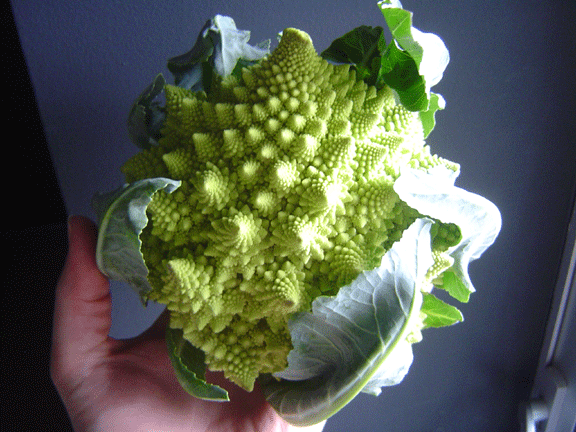
Yesterday morning at the Austin farmer's market, Sarah pointed out some Romanesco cauliflower to me.  This  fractal food is so pretty that we had to get one!  Sarah teased me on the way home for coddling it like a baby, and I must admit that except for the fact that it will go bad otherwise, I don't know that I could ingest something this beautiful.  I'd rather display it on our book shelf.

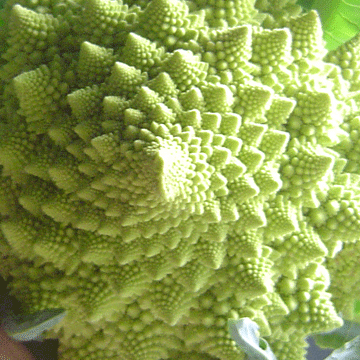
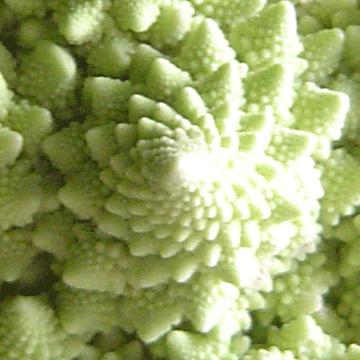
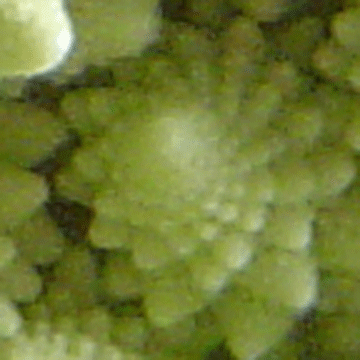
I took the following pictures of successive, self-similar levels of my little bundle.  Our aging camera wasn't quite up to the task, but I could get 3 levels pretty well.  In person, you can see an additional 4th level (bumps on the bumps in the final picture).


The Fibonacci sequence lives here.
In the botanical application of the Fibonacci numbers, plant outgrowths seek an optimum amount of living space and in so doing sprout in a pattern of intercrossing "whorls."  In a sunflower, where the buds become seeds, one family of 55 clockwise whorls intersects another family of 89 counterclockwise whorls - 55 and 89 being successive Fibonacci numbers.
Siobhan Roberts, King of Infinite Space, p259
Sure enough, I counted the number whorls to be 8 and 13 (the 6th and 7th Fibonacci numbers), regardless of the fractal level!  Sometimes the 8 whorls were clockwise, sometimes counterclockwise, and the direction changed even among outgrowths of the same level.  It'd be interesting to study the pattern of whorl directions to figure out what makes them flip.  I did notice outgrowths with similar whorl directions tend to clump together.

$4 was a steal for all this math magic!

Saturday, February 7, 2009

The Nature of Man

Does 00 = 1 or 0?  Does a human = good or evil?  It appears a bit confusing when you note the following:

x0 = 1 for any x not equal to 0.
0y = 0 for any y not equal to 0.

"Consensus has recently been built around setting the value of 0^0 = 1."

For these questions, I think I might like the answer "yes" better :) It depends on the context.